CIO comment
The framework conditions point to a fundamentally constructive environment: solid global growth, declining inflation and monetary easing – at least in the US – can support risk assets. At the same time, political uncertainties, valuation issues and regional divergences are increasing.
 "CIO Karin Kunrath, Raiffeisen Capital Management")
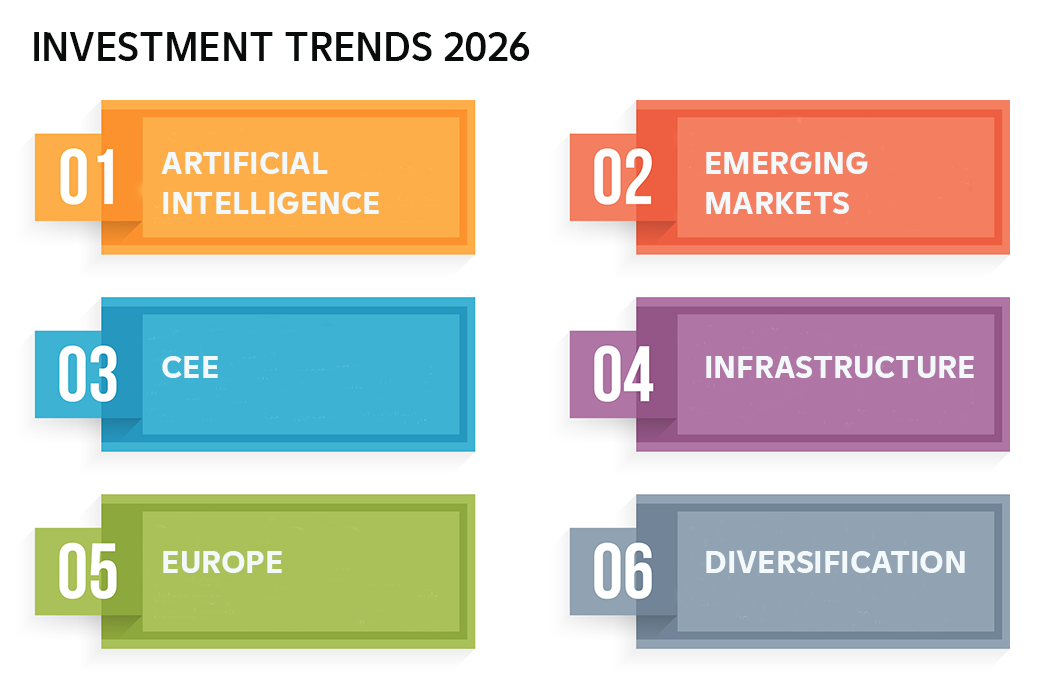
Against this backdrop, thematic allocations, regional differentiation and conscious diversification are becoming even more important. Artificial intelligence, emerging markets, infrastructure investments and a possible European comeback are central pillars of the 2026 capital market strategy.
Trend 1: Artificial intelligence:
From hype to monetisation
Artificial intelligence will remain the dominant structural investment trend in 2026. However, the focus is increasingly shifting from pure expectation to actual monetisation.
The "Magnificent 7"* remain at the centre of this ecosystem – not only as developers, but above all as operators of the global AI infrastructure. The investment cycle of the major hyperscalers is reaching new dimensions. High double-digit billion amounts are flowing into data centres, chips, networks and energy supply. These investments are not an end in themselves, but rather an expression of strategic positioning: AI is becoming the central platform for productivity gains, new business models and economies of scale.

The increasing penetration of the real economy is crucial for the capital markets. AI applications increase efficiency, reduce costs and open up new sources of revenue – not only in the technology sector, but also in industry, healthcare, financial services and infrastructure. This brings the connection between AI investments, economic growth and profit development more into focus.
The high valuations of individual equities remain a topic of discussion. Unlike in previous technology cycles, however, these valuations are backed up by substantial cash flows, high margins and real investment programmes. Short-term volatility remains possible, but structurally, AI is less of a cyclical issue and more of a new technological basis for global growth.
Trend 2: Emerging markets
Structural strength after a strong previous year
After exceptionally strong performance in 2025, emerging markets are expected to see normalised but still positive development in 2026.
Emerging markets now account for around two-thirds of global economic growth and are growing significantly faster than developed economies.
According to current estimates, Asia remains the key growth driver. Korea and Taiwan are likely to continue to benefit from the global semiconductor and AI infrastructure boom, while China is becoming more attractive despite geopolitical tensions and structural challenges – particularly in the technology sector and AI-related business models. India remains one of the most exciting investment destinations in the long term, even if high valuations require a selective approach in the short term.
Latin America and parts of Eastern Europe complement the picture with currently attractive valuations, high real interest rates and progress in structural reforms. On the bond side, both hard currency and local currency bonds remain interesting, with a weaker US dollar providing additional tailwinds. The key to 2026 will be less a broad rally and more active allocation, regional differentiation and a targeted selection of countries and sectors.
Trend 3: CEE
Convergence growth in the European context
Central and Eastern Europe will play a special role in 2026. The region is currently growing faster than the eurozone in structural terms and is benefiting from EU funds, nearshoring trends and close industrial ties with Western Europe.
While fiscal and political risks remain in individual countries, the overall picture is robust: rising real incomes, investment in infrastructure and increasing integration into European value chains. For investors, CEE thus offers a mix of emerging market dynamics and European stability.
Trend 4: Infrastructure
Das Rückgrat der Kapitalmärkte 2026
In 2026, infrastructure will evolve from a defensive add-on topic to a key growth story.
Global investment needs are enormous, driven by the energy transition, digitalisation, urbanisation and supply chain resilience.
The extensive investment programmes in Germany are particularly noteworthy. Public funds are increasingly being channelled into transport, energy, networks, digitalisation and housing. These programmes not only stabilise the economy but also set in motion a longer-term investment cycle that will extend well beyond 2026.

Infrastructure is thus becoming a strategic link between several megatrends:
Energy and climate transformation
Digitalisation and AI infrastructure
Europe's industrial competitiveness
For Europe as a whole, this will result in a new growth story. After years of structural underperformance, infrastructure investment, fiscal stimulus and a gradual economic recovery could make Europe a rebound candidate – especially relative to the highly valued US markets.
Trend 5: Europe
From problem child to comeback candidate?
Europe will start 2026 from a position of low expectations. This may offer opportunities. Moderate valuations, fiscal stimulus – led by Germany – and economic stabilisation create an asymmetric risk/reward profile.
In addition, European companies are benefiting indirectly from global trends such as AI and infrastructure, even if they are not the centre of attention. Broader market participation and a rotation towards substance, small and mid caps appear plausible as the year progresses.
Trend 6: Diversification
Key strategy after a strong 2025
Following the broad and strong performance of almost all asset classes in 2025, diversification will become significantly more important in 2026. The US midterm elections, geopolitical tensions and high market concentration will increase the potential for volatility. In an environment where many markets already have ambitious valuations, it will become more difficult to generate returns from a single asset class. Regional diversification, thematic diversification and the targeted use of different asset classes, taking currency risks (US dollar, Japanese yen, etc.) into account, will once again come into focus.
Conclusion
In summary, 2026 is not a year for simple market theses, but for differentiated capital market strategies. Artificial intelligence, infrastructure and emerging markets remain structural growth drivers. Europe and CEE offer catch-up potential, while diversification is becoming a key prerequisite for stable portfolio returns.
Structural growth trends are also subject to cycles and setbacks, which is why a long-term perspective is always needed when investing. The investment structure is largely defined by the investor's risk/return expectations, but fund savings offer a sensible opportunity to invest gradually and thus build up capital continuously with less risk, thereby taking advantage of long-term market trends.
*The Magnificent 7 are the tech companies Apple, Nvidia, Alphabet, Meta, Amazon, Tesla and Microsoft.