What is smart energy?
Smart energy stands for innovative technologies and business models that generate, transport, store and use energy in a cleaner, more efficient and more intelligent way. The transformation required to achieve this will necessitate investments of several trillion euros worldwide over the coming decades.
Investment opportunities offered by smart energy
- This megatrend offers attractive long-term opportunities but does not guarantee investment success. After the initial euphoria, investors have been taking a much more selective approach for several years now.
- A careful, well-chosen selection of stocks and active management are therefore crucial for long-term investment success.
- Political developments, the granting, modification or even termination of government subsidies, new regulations, and new technological achievements offer both opportunities and risks.
Raiffeisen-SmartEnergy-ESG-Aktien (equities)
The fund invests globally in equities of companies that benefit significantly from the energy transition ("smart energy" themes). The fund pursues an active, fundamental bottom-up approach. This means that shares are selected primarily on the basis of the specific economic situation and earnings prospects of the individual companies. While macroeconomic trends are taken into account, they play a subordinate role in investment decisions. The fund management applies the GARP principle ("Growth at Reasonable Price") when selecting equities, i.e. it focuses on companies with good growth and reasonable share valuations. Companies must meet strict sustainability criteria in order to be considered for investment.
Key investment areas
- Renewable energy (especially wind and solar energy)
- Energy distribution (especially modernisation and expansion of power grids)
- Efficient energy use (smart cities, green buildings, energy efficiency)
- Energy management (energy meets information technology, smart metering, etc.)
- Energy storage (stationary and mobile batteries)
- Electromobility

Raiffeisen-SmartEnergy-ESG-Aktien
Investing smartly in the energy transition
Current developments and challenges
- The expansion and modernisation of power grids are currently offering strong growth. There is a massive need for investment worldwide, but also very strongly in the EU and the US. In Europe and the US, grid infrastructure is often outdated and/or incapable of handling the rapidly increasing demand for electricity driven by electrification, digitalisation and the proliferation of new data and computing centres.
- The expansion of renewable energies requires large amounts of battery storage (global installations are currently skyrocketing).
- Building efficiency: The EU's renovation wave continues and requires enormous investment (persistently high demand with >75% of buildings inefficient).
- Renewable energies: The expansion of wind and solar energy continues worldwide, even if growth rates in China, for example, could slow down in the near future, albeit from very high levels.
- Hydrogen: Disillusionment has set in in this area for the time being, given high costs, technological hurdles and project delays, among other things. However, efforts in this area are continuing, especially in China.
Challenges remain, such as political uncertainty (e.g. in the United States, but potentially also in other countries), rising raw material prices due to strong demand and limited supplies, and relatively high interest rates (and thus financing costs for many of these long-term projects). On the other hand, prices for solar panels and battery storage continue to fall, mainly thanks to more efficient production processes and economies of scale through mass production.
Current market developments and outlook
2025 saw a strong recovery in share prices in many segments of the smart energy universe that had suffered heavy setbacks in previous years, particularly in the wind and solar energy sectors. Some areas, particularly those related to grid expansion, energy efficiency and the components and technologies required for this, did not experience these setbacks, or only to a limited extent, and performed well again in 2025.
Despite rising share prices, valuations remain attractive in large parts of the smart energy universe. For most companies in the electric mobility segment, the situation remains difficult for the time being. Despite growth, profit margins for manufacturers and suppliers are under pressure or remain relatively low. However, consolidation among the numerous players and further falling battery prices could lay the foundation for rising profits and improved share performance in this sector.
Sustainability in Raiffeisen SmartEnergy ESG equities
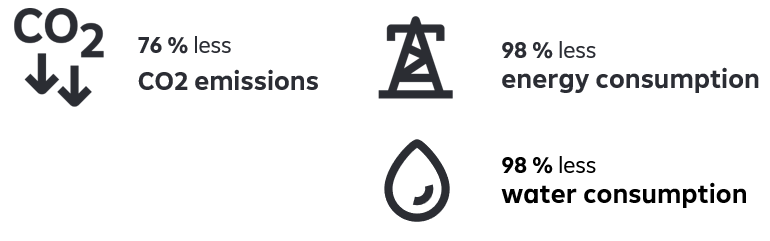
Companies involved in nuclear power, coal, gas or oil production are not accepted into the portfolio or are removed if they expand into these business areas. This selection of stocks based on economic and sustainability criteria means, among other things, that investments in Raiffeisen SmartEnergy ESG Equities have a significantly lower carbon footprint than conventional energy funds.
A key yardstick for determining whether a company is eligible for investment by the fund is the in-house Raiffeisen ESG indicator.
The Raiffeisen Kapitalanlage-Gesellschaft m.b.H. continually analyses companies and countries with the help of internal and external research providers. Together with an overall ESG assessment including an ESG risk assessment, the results of the sustainability research are converted into the so-called Raiffeisen ESG Indicator, which is based on a scale of 0 - 100. The assessment is made in consideration of the company’s respective branch of business.
At the end of 2025, the sustainability concept of the Raiffeisen SmartEnergy ESG Equity Fund was once again awarded the coveted sustainability seal of approval by the Forum Nachhaltige Geldanlagen (Forum for Sustainable Investment) and received the top rating of three stars.
Conclusion
Raiffeisen-SmartEnergy-ESG-Részvény Alap offer investors a broadly diversified and sustainable investment in the megatrend of energy transition/energy supply with a focus on promising smart energy topics. However, investments in this area do not guarantee success; they require careful selection, constant monitoring and, if necessary, adjustments. An actively managed fund solution therefore makes particularly good sense. The risks generally associated with equity investments of course also apply to companies involved in the smart energy sector. These include price fluctuations and even possible capital losses, and a long-term investment horizon of at least 10 years is recommended.
*Raiffeisen Kapitalanlage-Gesellschaft m.b.H. continually analyses companies and countries with the help of internal and external research providers. Together with an overall ESG rating including an ESG risk assessment, the results of the sustainability research are converted into the so-called Raiffeisen ESG Indicator. The Raiffeisen ESG Indicator is measured on a scale of 0-100. The assessment is made in consideration of each company’s respective branch of business. Further information can be found in German at Raiffeisen-ESG-Indikator and in English at Raiffeisen ESG Indicator.
The fund Raiffeisen-SmartEnergy-ESG-Aktien exhibits elevated volatility, meaning that unit prices can move significantly higher or lower in short periods of time, and it is not possible to rule out loss of capital.